
The RAG Gap: Why Industrial Knowledge Retrieval Is Harder Than It Looks
Your factory has decades of knowledge. Your AI can't find any of it.

Ask any enterprise chatbot a question and you’ll get a fluent answer in under two seconds. Ask it about the specific failure mode your hydraulic press exhibited last March — the one where the ram seal started leaking only during third-shift runs when ambient temperature dropped below 15°C — and you’ll get a confident, plausible answer with no way to ground it in your actual operating history.
This isn’t a complaint about any general-purpose AI. It’s a structural observation about where AI retrieval works and where it falls apart. And that gap — between what retrieval-augmented generation (RAG) can do with clean, digitally-native text and what it can’t do with the messy, fragmented, multi-format knowledge that lives inside typical industrial operations — is one of the most under appreciated barriers to industrial AI adoption.
Retrieval systems work differently depending on the domain. In digitally native enterprise automation, the standard RAG playbook delivers. But the industrial knowledge problem isn’t just hard — it’s hard in ways that current RAG playbooks weren't designed to handle.

What RAG actually is (and isn’t)
If you’ve been reading about AI in the last two years, you’ve encountered RAG. The concept is straightforward: instead of relying solely on what a language model memorised during training, you retrieve relevant documents at query time and feed them to the model as context. The model generates an answer grounded in your actual data, not its training corpus.
It works remarkably well for certain types of knowledge. Company wikis. Product documentation. Legal contracts. Customer support transcripts. Any domain where knowledge lives in clean, well-structured text documents that can be chunked, embedded into vector space, and retrieved by semantic similarity.
The enterprise RAG market has exploded on this premise. Vendors promise that you can “chat with your data” and unlock institutional knowledge trapped in PDFs and SharePoint folders. And for digitally-native organizations — software companies, financial services, consulting firms — these promises largely deliver.
Industrial space is not a digitally-native sector. And that’s where the story changes.
The numbers bear this out. Enterprise RAG adoption has surged — from 31% to 51% in just one year, with vector database usage up 377%. But dig into where RAG is working and where it isn’t, and a pattern emerges: it thrives in text-rich, digitally-native domains and stalls in environments where knowledge is physical, fragmented, and never born digital. Typical industrial sectors — manufacturing, agriculture, energy, mining — sit squarely in the second camp.
The seven layers of industrial knowledge that RAG can’t reach
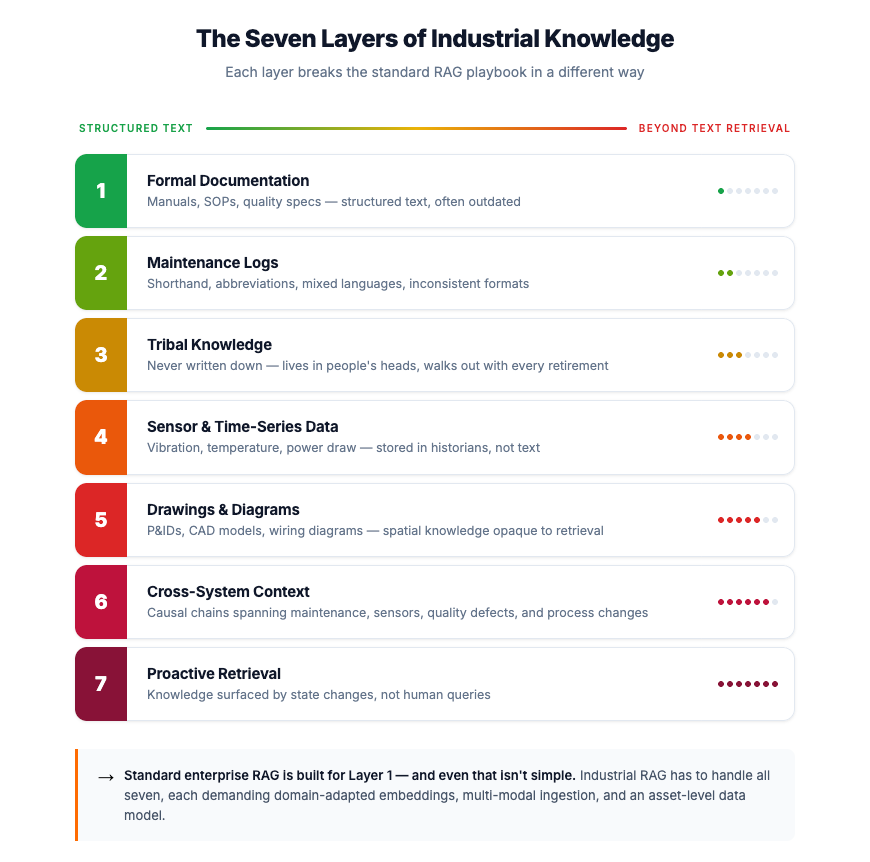
Walk into any factory that’s been operating for more than a decade and you’ll find knowledge distributed across at least seven distinct layers. Each one presents a different retrieval challenge, and most of them break the conventional RAG approach.
Layer 1: The formal documentation nobody reads.
Every factory has manuals. Equipment manuals, process specifications, quality procedures, safety protocols. In theory, this is the easiest layer — structured text, often in PDF form, perfect for chunking and indexing. In practice, these documents are frequently outdated, written in vendor-specific jargon, and disconnected from how the equipment is actually operated. The manual says the torque setting is 45 Nm. The operator who’s been running that machine for twelve years knows it’s actually 42 Nm because the fixture has worn down and the manual was never updated.
A RAG system will retrieve the manual. It will confidently cite 45 Nm. It will be wrong.
Layer 2: Maintenance logs written by humans in a hurry.
Maintenance logs are where some of the richest operational knowledge lives — and they’re a retrieval nightmare. They’re written in shorthand, riddled with abbreviations that vary by shift and by technician, and they mix structured fields (date, equipment ID, work order number) with free-text descriptions that range from detailed diagnostics to “fixed it.” We’ve seen maintenance entries that say “same problem as last time” with no reference to what last time was. We’ve seen entries written in a mix of English and Spanish, sometimes in the same sentence. We’ve seen critical root-cause information buried in a field labelled “additional notes” that no retrieval system would prioritize.
Standard text embeddings — the kind that power most RAG systems — were trained on internet text. They understand the semantic similarity between well-formed English sentences. They do not understand that “spndl brng OT 3rd sft humid” means the spindle bearing overheated during the third shift in humid conditions. Research on Technical Language Processing in maintenance contexts confirms what any plant engineer already knows: maintenance text is full of domain-specific jargon, inconsistent abbreviations, and incomplete entries with no standardized format. Researchers at the University of Western Australia built MaintIE, a fine-grained information extraction benchmark for maintenance texts, with 224 entity types and 1,076 annotated records — but that’s one of the only labelled datasets of its kind. Domain-specific embedding models exist, but fine tuning them requires labelled data that most manufacturers don’t have and can’t easily create.
Layer 3: The tribal knowledge that was never written down.
This is the layer that keeps manufacturing leaders awake at night. The veteran operator who can hear a bearing starting to fail before any sensor picks it up. The maintenance tech who knows that Machine 7 runs hot on Tuesdays because of the HVAC pattern in the adjacent bay. The quality engineer who learned — through twenty years of trial and error — which material lots from which suppliers tend to cause dimensional drift.
None of this is documented. It lives in people’s heads. And it’s walking out the door: the median age of a U.S. manufacturing worker is north of 44, and over a quarter of the workforce is 55 or older. RAG systems can’t retrieve knowledge that doesn’t exist in any retrievable format. Before you can build a retrieval pipeline, someone has to capture the knowledge — and that’s a human problem, not a technology problem.
Layer 4: Sensor data that speaks a different language entirely.
Modern factories generate enormous volumes of sensor data — vibration, temperature, pressure, power draw, dimensional measurements. This data contains knowledge. The vibration signature that precedes a bearing failure by 72 hours. The temperature curve that indicates a coolant flow restriction. The power draw anomaly that correlates with tool wear.
But this isn’t text. It’s time-series numerical data, often sampled at high frequency, stored in historians or SCADA systems that predate the cloud by decades. You can’t embed a vibration waveform into the same vector space as a maintenance log and expect cosine similarity to find meaningful connections. Multimodal RAG — the emerging approach that embeds images, audio, and tabular data alongside text — is making progress. TS-RAG, published at NeurIPS 2025, demonstrated a 6.84% performance improvement in zero-shot time-series forecasting by retrieving semantically relevant temporal segments. And RAAD-LLM, validated on a real plastics manufacturing plant in early 2025, achieved 88.6% anomaly detection accuracy by combining RAG with sensor data analysis — up from 70.7% without retrieval. These are real results. But they’re still single-plant validations, not scalable production deployments across heterogeneous equipment.
Layer 5: The drawings and diagrams that encode spatial knowledge.
P&IDs. Wiring diagrams. Tolerance stackups. Assembly drawings. CAD models. These documents encode critical knowledge about how systems are connected, how components relate spatially, and what the design intent was behind a particular configuration.
Current RAG systems are essentially text-retrieval systems. Even the multimodal ones that can “see” an image typically extract text from it (via OCR) or generate a text description, then retrieve against that description. Try this with a piping and instrumentation diagram and you’ll get a text description of shapes and lines, not an understanding that valve V-2034 is upstream of heat exchanger HX-101 and downstream of pump P-405.
The research community is working on this. PIDQA, a 2024 benchmark with 64,000 question-answer pairs over P&IDs, showed that converting diagrams into labelled property graphs and then translating queries into graph-database queries (Cypher) can improve accuracy 10.6–43.5% over naive approaches. Commercial tools are emerging too: VIKTOR.AI and DiagramIQ both offer conversational access to engineering drawings, and Symphony AI uses multimodal LLMs for P&ID ingestion. But MIT’s DesignQA benchmark — testing leading models including GPT-4o and Claude-Opus on engineering documentation — found that even frontier models still struggle with reliable technical component recognition and spatial reasoning in CAD drawings. The spatial and relational knowledge encoded in engineering documents remains one of the hardest retrieval problems in AI.
Layer 6: The context that connects everything.
Knowledge in a factory is rarely useful in isolation. The maintenance log matters because of the sensor reading that preceded it. The process change matters because of the quality defect that followed it. The supplier switch matters because of the material property shift that cascaded into a dimensional tolerance issue three operations downstream.
This is the knowledge graph problem. Individual facts are retrievable. The connections between them — the causal chains, the temporal relationships, the cross-system correlations — are what make those facts actionable. Building knowledge graphs is expensive — industry estimates put extraction at 3–5x the cost of baseline RAG, with entity recognition accuracy ranging from 60–85% depending on domain specificity. Standards like ISA-95 and ISO 15926 provide ontological frameworks for industrial data relationships, but implementing them as live knowledge graphs that ingest from real-time data streams is a different order of engineering. A 2024 study on GraphRAG for manufacturing showed consistent improvements in context relevance over naive RAG — especially for multi-hop questions that require connecting information across documents — but the extraction cost remains a barrier. Most manufacturers aren’t even at baseline RAG yet.
Layer 7: The knowledge you don’t know you need.
In consumer-facing RAG applications, the user asks a question and the system retrieves an answer. The query drives the retrieval. In an industrial context, some of the most valuable retrievals would be proactive — surfacing relevant historical knowledge before a problem occurs. The system should recognise that the current vibration pattern on Machine 12 is similar to the pattern that preceded a catastrophic failure on Machine 8 in 2019, and retrieve the root-cause analysis and corrective actions from that incident without anyone asking.
This isn’t RAG as it’s currently understood. It’s something closer to continuous knowledge monitoring — retrieval triggered by state changes rather than human queries. The architecture is fundamentally different from a chatbot that answers questions. But it’s no longer purely theoretical. PARAM (Prescriptive Agents based on RAG for Automated Maintenance) uses a three-tiered architecture — anomaly detection triggers contextual knowledge retrieval, which feeds prescriptive decision-making — to generate maintenance recommendations from bearing vibration signatures. It serializes sensor data (bearing pass frequencies, fault frequencies) into natural language that an LLM can reason about, then retrieves relevant maintenance procedures. Early-stage, but the architecture points to where industrial RAG needs to go: from reactive search to proactive intelligence.
Why the standard RAG playbook fails in industrial environments
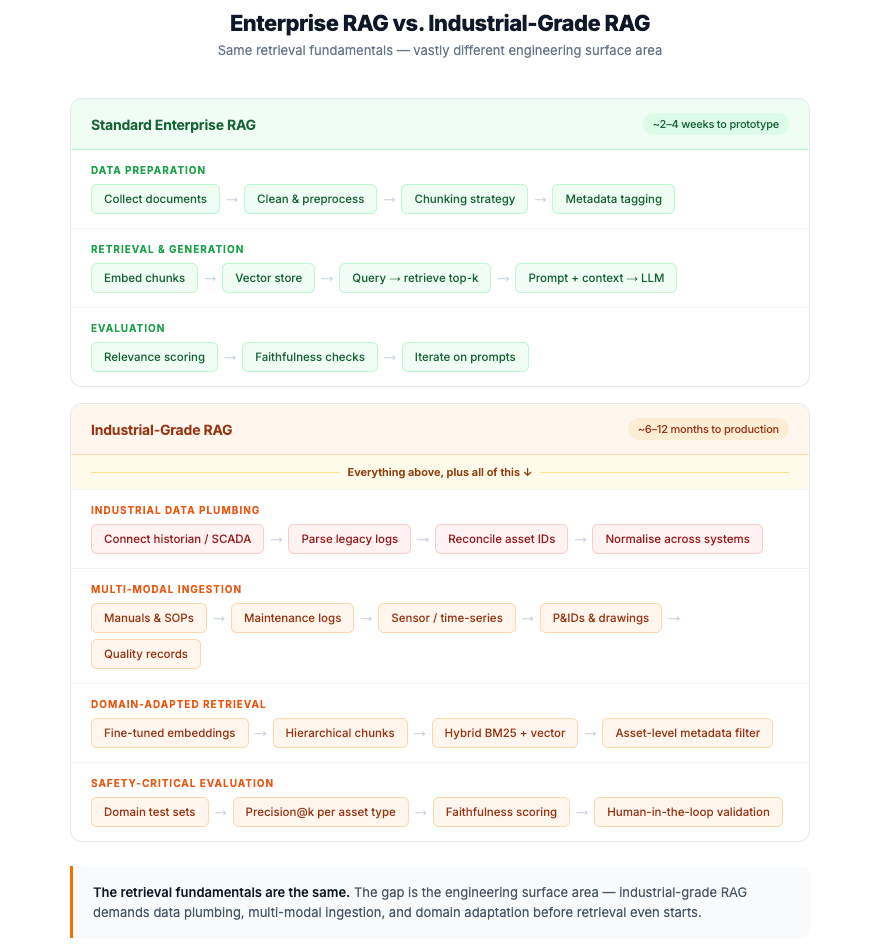
If you’ve built a RAG system, you know the architecture: ingest documents, chunk them, generate embeddings, store them in a vector database, retrieve the top-k most similar chunks at query time, and feed them to a language model for answer generation.
Each step in this pipeline has assumptions baked into it. And nearly every assumption breaks in a industrial context.
Chunking assumes coherent text. Standard chunking strategies — fixed-size, sentence-level, or paragraph-level splits — assume the source material is well-formed prose. Industrial documents are tables, forms, annotated drawings, and shorthand logs. Chunking a maintenance work order the same way you chunk a product manual destroys the relational structure that gives it meaning.
Embeddings assume a shared semantic space. General-purpose embedding models (the ones most RAG systems use) were trained on internet-scale text. They’re excellent at understanding that “automobile” and “car” are similar. They’re terrible at understanding that “OT” means “overtime” in an HR document but “over temperature” in a maintenance log. Domain adaptation is possible — but it requires curated training data that most players in the industrial space don’t have and can’t easily create.
Retrieval assumes the answer is in the text. Vector similarity search finds the passages most semantically similar to the query. But in industrial environments, the answer often isn’t in any single passage — it’s in the relationship between a maintenance log, a sensor trend, a process change order, and a quality report. No single chunk contains the answer. The answer emerges from connecting multiple sources across different systems, formats, and time periods.
Generation assumes the model can reason about the domain. Even when retrieval works perfectly, the language model still needs to reason about the retrieved context to generate a useful answer. Industrial reasoning often requires understanding of physics, process dynamics, and causal relationships that language models don’t have. A model that can summarise a legal contract beautifully may not be able to interpret a retrieved vibration analysis report correctly — because interpretation requires domain knowledge the model was never trained on.
Under the hood: What a industrial-grade RAG pipeline actually requires
A technical deep-dive for readers who build these systems.
The gap between a demo-ready RAG prototype and a production-grade industrial retrieval system is roughly 10x the engineering effort. Here’s what the production version demands:
Multi-modal ingestion. You need separate processing pipelines for structured text (manuals, SOPs), semi-structured text (maintenance logs, work orders), tabular data (quality records, inspection results), time-series data (sensor historians), and visual data (engineering drawings, inspection images). Each pipeline has its own preprocessing, cleaning, and normalisation logic. There is no single ingestion path.
Domain-adapted embeddings. Off-the-shelf models like text-embedding-3-large or all-MiniLM-L6-v2 work for general knowledge bases. For manufacturing, you need embeddings fine-tuned on domain-specific data. Research on contrastive fine-tuning with expert-augmented scores shows that even small, well-curated training sets can produce significant precision lifts — ARK (Answer-Centric Retriever Tuning) documented a 14.5% F1-score improvement across retrieval benchmarks, and other studies report precision gains of up to 30 points depending on the domain. The first manufacturing-specific embedding models are beginning to emerge — a 2025 paper on embeddings for Industry 4.0 agents defines nine retrieval task types derived from ISO standards — a sign that the field is starting to formalise what “good retrieval” means in industrial contexts. But for most teams today, the practical path is contrastive fine-tuning on their own domain data. The investment is in curation, not computation.
Hybrid retrieval. Pure vector search misses exact matches on equipment IDs, part numbers, and work order references — the structured identifiers that manufacturing queries frequently include. You need a hybrid strategy: semantic (vector) search for conceptual similarity, combined with keyword/metadata filtering for precise identifiers. The standard approach is a weighted fusion of BM25 (sparse) and vector (dense) similarity — the exact weighting depends on the corpus (documentation-heavy domains may favour BM25 at 0.7, while free-text-heavy domains push vector similarity higher), and Reciprocal Rank Fusion offers an alternative that avoids raw score calibration entirely. Either way, hybrid consistently outperforms either method alone.
Hierarchical chunking with metadata preservation. A standard RAG system treats every chunk the same — a flat list of text fragments. Manufacturing documents have structure that matters: a maintenance log has a header (equipment ID, date, shift, technician) and a body (the actual diagnosis). Flatten that into uniform chunks and the system loses the ability to answer “show me all third-shift maintenance entries for Machine 12 in the last 90 days.” The fix: chunk documents hierarchically — document → section → entry — and tag each level with metadata (equipment ID, date, shift, plant). This lets the system narrow the search space before vector similarity even runs.
Evaluation loops — the non-negotiable. Production RAG without evaluation is flying blind. You need both offline evaluation (curated test sets with ground-truth answer passages) and online monitoring (retrieval precision at k, answer faithfulness scores, user feedback signals). Most enterprise RAG deployments — by some estimates, 70% — still lack systematic evaluation frameworks. In manufacturing, where a wrong answer could mean downtime or a safety incident, this isn’t optional. Build the evaluation harness before you build the pipeline.
The first ninety miles are data engineering
There’s a maxim that floats around enterprise AI circles: the model isn’t the hard part — the data infrastructure is. Practitioners put the ratio as high as 80/20, data plumbing to model work. We used to think that was a convenient excuse for slow progress. After building retrieval systems across multiple domains, we think it might be an undercount.
In a consumer application, the data pipeline is: ingest clean text → chunk → embed → retrieve → generate. In a manufacturing application, before you even get to the RAG pipeline, you need to: connect to a historian that runs on a protocol from 2003, extract data from a SCADA system that was last updated when the plant was built, parse maintenance logs entered through a terminal interface that doesn’t support Unicode, reconcile equipment IDs that were renamed during a plant reorganisation in 2018, and figure out that “Machine 12,” “M-12,” “Line 3 Station B,” and “the one next to the break room” all refer to the same asset.
IDC estimates that up to 90% of enterprise data remains locked in unstructured silos. In manufacturing, the situation is arguably worse — because the data isn’t just unstructured. It’s multi-format, multi-system, multi-decade, and frequently multi-language. The RAG pipeline is the last mile. The first ninety miles are data engineering.
This is where the skills typically associated with ML engineers and data scientists — pipeline orchestration, ETL design, data quality frameworks, schema reconciliation — become more important than anything related to language models or vector databases. The unsexy truth about industrial RAG is that most of the value comes from the plumbing, not the model.
Who’s actually building this
The picture isn’t all gaps. A growing number of vendors and open-source projects are attacking pieces of the industrial RAG problem — and understanding where they’ve succeeded and where they’ve stalled tells you a lot about what works.
Siemens Industrial Copilot, built on Azure OpenAI and available since mid-2024, is probably the most visible effort. It uses RAG to ground LLM responses in Siemens’ automation and process documentation. Over 100 companies are using it, including thyssenkrupp, and Siemens reports that engineers can generate panel visualisations in 30 seconds with code requiring only 20% manual adaptation. But it’s optimised for Siemens’ own ecosystem — TIA Portal, Xcelerator — which means it works best when your data is already in Siemens’ formats.
Augmentir takes a different approach with Augie, their AI suite for frontline workers. Rather than trying to answer open-ended questions, it combines RAG with workforce skills data and quality records to guide technicians through procedures. In April 2025, they launched an Industrial AI Agent Studio — no-code agents for maintenance, quality, and training workflows. Practical. Narrow. Useful.
Cognite has bet on data modelling as the foundation layer. Their Cognite AI platform combines LLMs with their proprietary data model — a structured representation of industrial assets and relationships — to retrieve from private customer data. It’s a GraphRAG-adjacent approach, and it works well for customers who’ve invested in structuring their data through Cognite’s platform. The catch: that investment is substantial.
On the open-source side, tools like LlamaIndex (optimized for hierarchical chunking, auto-merging retrieval, and sub-question decomposition) and LangChain (better for dynamic multi-tool workflows) provide the building blocks. Neither is manufacturing-specific, but both are increasingly used by industrial teams stitching together custom pipelines. For manufacturing safety specifically, researchers built a multimodal RAG chatbot grounded in OSHA and OEM documentation and tested it on real equipment — a Bridgeport manual mill, a Haas TL-1 CNC lathe, and a Universal Robots UR5e — achieving 86.7% accuracy at $0.005 per query.
The common thread: the solutions that work target a specific slice of the problem (documentation retrieval, frontline guidance, safety procedures) rather than trying to solve the entire seven-layer knowledge stack at once. General-purpose “chat with your factory data” remains marketing more than reality.
What industrial teams can steal from domains that got there first
If the picture sounds bleak, it’s because we’re describing the full problem honestly. But there are paths forward, and some of them are already working in adjacent domains.
From fintech: evaluation-driven development. Financial services learned the hard way that AI systems handling money need rigorous evaluation before deployment — not after. Metrics like precision@k, NDCG, and faithfulness scoring are standard in fintech AI. Manufacturing should adopt the same discipline. Before you deploy a RAG system that advises a technician on a repair procedure, you need to know its retrieval accuracy on your actual data, with your actual queries, evaluated by your actual domain experts. Not a vendor demo. Not a benchmark score. Your data.
From search: hybrid retrieval as the default. The information retrieval community solved the “exact match vs. semantic match” problem years ago with hybrid search architectures. Industrial RAG systems should start here — not with pure vector search, which will miss every query that includes a part number, equipment ID, or maintenance code.
From healthcare: human-in-the-loop as architecture, not afterthought. Medical AI systems build expert review into the workflow because the stakes demand it. Manufacturing should do the same. A RAG system that surfaces a recommended repair procedure should include confidence scores, source attribution, and a clear path for a human expert to validate or override. This isn’t a concession — it’s how you build trust with a workforce that has good reasons to be sceptical.
From consumer AI: start with the retrieval, not the generation. The most successful consumer RAG deployments — internal knowledge bases, customer support systems — got traction by focusing on retrieval quality first and generation quality second. A system that retrieves the right documents and presents them to a human is immediately useful. A system that generates a fluent but hallucinated answer is worse than nothing. For industrial settings, where hallucinated maintenance advice could cause real damage, this ordering isn’t just strategic. It’s a safety requirement.
The honest timeline
Vendors will tell you industrial RAG is ready now. Researchers will tell you the hard problems are nearly solved. The truth, from practitioners who’ve built these systems, is somewhere in the middle — and it’s more nuanced than either camp admits.
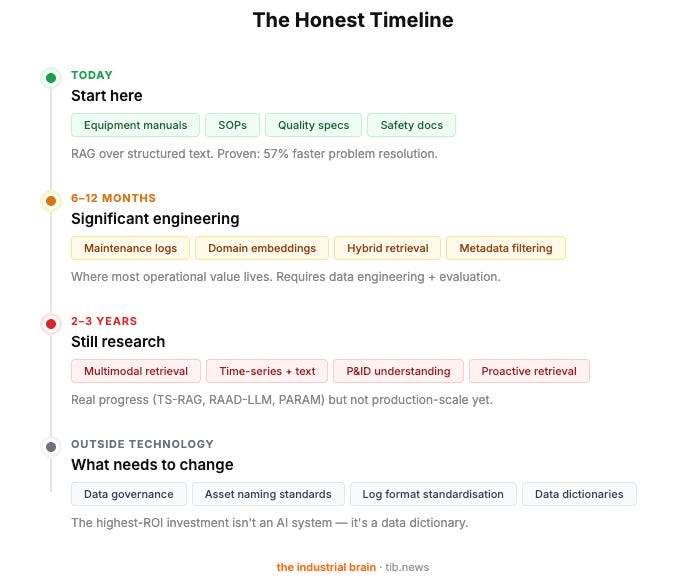
What works today: RAG over well-structured documentation — equipment manuals, standard operating procedures, quality specifications. If the knowledge is in clean text and the queries are straightforward, current tools can deliver meaningful value. One electronics manufacturer deployed RAG across a million-plus pages of technical documentation and cut problem-resolution time from 4.2 hours to 1.8 — a 57% reduction, with annual downtime losses down by roughly $250K. Start here.
What works with significant engineering (6–12 months): Hybrid retrieval across maintenance logs and documentation, with domain-adapted embeddings and metadata-aware filtering. This is where most of the operational value lives, but it requires serious data engineering and ongoing evaluation. Don’t underestimate the integration effort.
What’s still research (2–3 years out): True multimodal retrieval across text, time-series sensor data, and engineering drawings. Proactive knowledge surfacing driven by equipment state changes rather than human queries. Cross-plant knowledge transfer that accounts for different equipment, processes, and naming conventions. The research is real — TS-RAG, RAAD-LLM, PARAM, and the P&ID benchmarks are all 2024–2025 work — but production deployment across heterogeneous brownfield environments is a different beast.
What needs to change outside technology: Data governance and standardisation. If every plant names equipment differently, logs maintenance in different formats, and stores sensor data in incompatible systems, no retrieval architecture will overcome the entropy. The highest-ROI investment most manufacturers can make isn’t an AI system — it’s a data dictionary.
The gap is the opportunity
We called this piece “The RAG Gap” because the distance between what RAG can do with clean, digitally-native content and what it needs to do with industrial knowledge is genuine and wide. But gaps are also where opportunities live.
Here’s what industrial knowledge retrieval actually looks like when it works. A technician on the second shift notices an unusual vibration on Machine 12. She types a query — or the system triggers one automatically from a sensor threshold. The retrieval pipeline pulls: the last three maintenance logs for that machine, the root-cause analysis from a similar vibration pattern on Machine 8 in 2019, the relevant section of the OEM manual for that spindle assembly, and the sensor trend overlay showing the correlation between vibration frequency and bearing temperature over the past 72 hours. All of it scoped to her specific equipment, her specific configuration, her plant’s naming conventions. She sees the sources, the confidence scores, and a recommended action — not a generated paragraph, but the actual documents with the relevant sections highlighted, plus a flag that says “this pattern preceded a bearing failure within 96 hours in two prior incidents.”
That’s not a chatbot. That’s institutional memory operating at the speed of a shift change. And the moat isn’t the language model generating the summary — it’s the asset-level data model underneath. The equipment registry that knows Machine 12 and M-12 and “Line 3 Station B” are the same asset. The metadata layer that tags every maintenance log with shift, technician, equipment ID, and failure mode. The ingestion pipeline that normalises abbreviations and connects sensor streams to the documents they explain. The evaluation harness that catches retrieval drift before a wrong recommendation reaches the floor.
The entire open-source AI ecosystem was built on the premise that shared knowledge compounds. The same principle applies here. The difference is that industrial knowledge is harder to share — not because anyone’s hoarding it, but because it was never in a shareable format to begin with.
That’s the engineering problem worth solving. And if our experience has taught us anything, it’s that the teams who treat data infrastructure as the main event — not a prerequisite to the main event — are the ones who’ll get there first. The model is the last 10%. The plumbing is everything.
If you think we’re underestimating — or overestimating — any of these barriers, we want to hear from you. Please comment below or reply to this email: theindustrialbrain@gmail.com
Written by The Industrial Brain team. We publish analysis covering the industrial space and the forces shaping it.
Further Reading
Retrieval-Augmented Generation in Industry: An Interview Study on Use Cases, Requirements, Challenges, and Evaluation — Arxiv, 2025. Real-world enterprise RAG deployment patterns and failure modes from practitioner interviews.
Application of RAG for Interactive Industrial Knowledge Management via LLM — ScienceDirect, 2025. Academic treatment of RAG applied to industrial knowledge retrieval.
MaintIE: A Fine-Grained Annotation Schema and Benchmark for Information Extraction from Maintenance Short Texts — ACL, 2024. The most comprehensive annotated dataset for maintenance text processing, with 224 entity types.
RAAD-LLM: Adaptive Anomaly Detection Using LLMs and RAG Integration — Arxiv, 2025. Real-world validation of RAG-based anomaly detection in a plastics manufacturing plant.
PARAM: Prescriptive Agents based on RAG for Automated Maintenance — Arxiv, 2025. Three-tiered architecture for state-change-triggered retrieval in predictive maintenance.
Document GraphRAG for Manufacturing — MDPI Electronics, 2024. Knowledge graph-enhanced RAG specifically evaluated on manufacturing documents.
DesignQA: A Multimodal Benchmark for Evaluating LLMs’ Understanding of Engineering Documentation — MIT/ASME, 2024. Benchmark showing where frontier models still fail on technical drawings and CAD.
The AI-Powered Codification of Tribal Knowledge — Omer’s Ventures. Investment perspective on capturing tacit knowledge before it disappears.
TS-RAG: Retrieval-Augmented Generation based Time Series Foundation Models — NeurIPS 2025. State-of-the-art approach to time-series retrieval for zero-shot forecasting.
Enterprise RAG Failures: The 5-Part Framework to Avoid the 80% — Analytics Vidhya, 2025. Common failure patterns in enterprise RAG deployments.
Evidence-Driven Reasoning for Industrial Maintenance Using Heterogeneous Data — Arxiv, 2026. Emerging approaches to reasoning across mixed industrial data types.