
Two AIs: Why the Intelligence That's Transforming Everything Else Can't Get Past the Factory Door
Digital AI scaled in months. Physical AI faces barriers that money alone can't solve. Here's what's actually in the way — and who's trying to break through.

Last week we’ve connected four signals to Jeff Bezos’s $100 billion manufacturing fund and argued that the bet is almost predictable when you see what manufacturers are facing. Scarce labour. Spiking costs. AI adoption stuck in pilot purgatory. Physical AI investment exploding.
But we left a question hanging: if AI is transforming knowledge work at breakneck speed, why is manufacturing — the industry that arguably needs it most — dead last in scaling it?
That’s this week’s article. And the answer isn’t “manufacturers are behind.” It’s that there are two fundamentally different kinds of AI, and the one that works in factories faces barriers the other one never had to deal with.
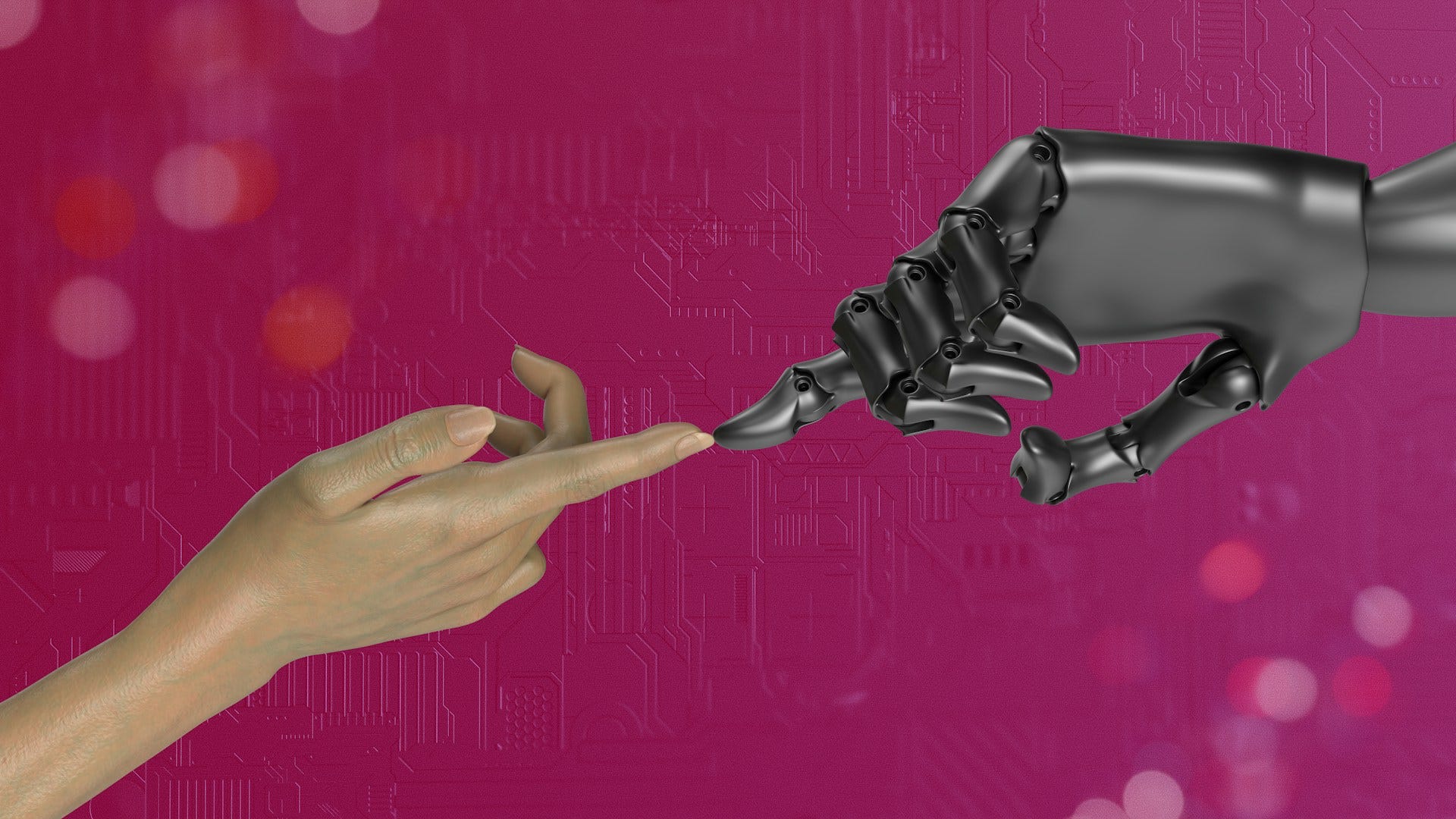
The tale of two AIs
Digital AI — the kind powering ChatGPT, Copilot, and the tools reshaping every office job — scaled fast because the conditions were perfect. The internet gave it virtually infinite training data. Cloud infrastructure gave it infinite compute. APIs gave it infinite distribution. A model trained on text can be deployed to millions of users overnight because the medium it operates in — information — moves at the speed of a network call.
Physical AI is a different animal entirely. It operates in the real world — factories, warehouses, roads, surgical theatres. It needs to understand physics: how materials behave under stress, how a robotic arm should grip an irregular object, how airflow changes around a turbine blade at different temperatures. Its training data doesn’t come from the internet. It comes from sensors, cameras, force-torque measurements, and thousands of hours of physical interaction. And its mistakes don’t produce a bad paragraph. They produce a crashed drone, a cracked component, or a failed batch worth six figures.
Digital AI learned from humanity’s collective text. Physical AI has to learn from the physical world — and the physical world doesn’t upload itself to the cloud.
That distinction explains nearly everything about where we are today.
The numbers that tell the story
We covered the McKinsey AI data in detail last week, but the headline numbers bear repeating because they set up everything that follows: 88% of organisations say they’re using AI. Only 7% are fully scaled. And manufacturing is dead last — 91% still experimenting, 2% scaling AI agents. The closer you get to the physical world, the harder AI is to scale.
The most recent data reinforces this. Redwood Software’s 2026 Manufacturing AI Outlook found that 98% of manufacturers are exploring AI-driven automation — but only 20% feel fully prepared to use it at scale. Seven in ten have automated 50% or less of their core operations. And Deloitte’s latest Physical AI research puts it even more starkly: only 3% of firms have Physical AI extensively integrated into operations today. Three percent.
What we didn’t dig into last week is why. The usual explanations — “manufacturers are risk-averse,” “the industry is slow to adopt technology” — are lazy and mostly wrong. Manufacturers adopted ERP, adopted lean, adopted Six Sigma, adopted industrial robotics. They’re not technophobic. They’re dealing with a fundamentally different problem.
The functions where AI is gaining traction — IT, knowledge management, marketing — are information work. The inputs are digital. The outputs are digital. The feedback loops are fast. Manufacturing runs on physics, not pixels. And that distinction changes everything about how AI can — and can’t — scale.
What Physical AI actually is
Before we get into the barriers, we want to be specific about what “Physical AI” actually means — because right now the term is being stretched to cover everything from a robotic arm picking boxes to a humanoid robot making coffee, and that’s not helpful.
The way we think about it: Physical AI is AI that has to deal with the real world — not just text or images on a screen, but actual materials, forces, and environments. And the companies building it are working across three layers:
Foundation models for the physical world. These are the equivalent of GPT or Claude but trained on physical interactions rather than text. Physical Intelligence (pi) has raised over $1 billion to build general-purpose robot foundation models — systems that can control different robot bodies across different tasks without being reprogrammed for each one. Skild AI just closed $1.4 billion at a $14 billion valuation in January 2026, building what they call an “omni-bodied” universal robot brain that generalises across quadrupeds, humanoids, tabletop arms, and mobile manipulators. These are the companies trying to do for robotics what GPT did for language.
Simulation and synthetic data. Since you can’t crash ten thousand real robots to train a model, the industry is building increasingly sophisticated simulation environments. NVIDIA’s Cosmos open foundation models generate photorealistic synthetic data from simulations, dramatically reducing the gap between virtual training and real-world performance. Their Physical AI Data Factory includes thousands of real robot trajectories plus tens of thousands of simulated ones. Recent research shows that with sufficiently large-scale synthetic training data, zero-shot sim-to-real transfer — a robot performing a task in reality that it only practised in simulation — is now feasible for manipulation tasks.
Hardware and deployment. The robots themselves are evolving fast. Figure AI has raised $1.9 billion and is vertically manufacturing humanoid robots at their BotQ facility in California. Apptronik closed a $935 million Series A at a valuation exceeding $5 billion in February 2026, with partnerships at Mercedes-Benz, GXO Logistics, and a strategic tie-up with Google DeepMind. In China, Unitree delivered 5,500+ units in 2025 and is targeting 10,000-20,000 in 2026, with models ranging from under $5,000 to nearly $30,000 depending on capability. AGIBOT shipped over 5,100 humanoid robots in 2025 and is targeting a Hong Kong IPO in 2026.
Global robotics funding hit $13.8 billion in 2025 — up from $7.8 billion in 2024, exceeding even the $13.1 billion raised during the 2021 SPAC peak. Figure is valued at $39 billion. Skild at $14 billion. Physical Intelligence at $5.6 billion. Twenty-seven Physical AI startups quietly raised $50 million or more in Q1 2026 alone. Two years ago these numbers would have been laughed out of the room.
So capital is clearly not what’s missing. What is?
Seven barriers between Physical AI and the factory floor
We spent the last two weeks reading everything we could find on why Physical AI isn’t scaling in manufacturing the way digital AI scaled in knowledge work. Most of what’s written falls into two camps: breathless optimism (”the ChatGPT moment is here!”) or vague hand-waving about “implementation challenges.” Neither is useful if you actually run a factory. Here’s what we’ve found when we looked at the specifics.
1. The training data gap
Digital AI had the internet — billions of pages of text, images, and code, freely available, already digitised. Physical AI has almost nothing comparable. Training a robot to pick and place objects requires thousands of real-world demonstrations or millions of simulated ones. Training it to navigate a specific factory layout, handle parts with different tolerances, and adapt to variable conditions requires even more.
NVIDIA’s Cosmos platform is attacking this with synthetic data generation, and the results are promising — synthetically trained models now perform comparably to real-data models in controlled environments. Gartner’s March 2026 predictions forecast that by 2030, synthetic data will constitute 95% of data used for training AI models in images and video, outpacing growth in real structured data. But there’s a catch: models trained exclusively on synthetic data can suffer from what researchers call “model collapse” — outputs that become increasingly disconnected from reality. The strongest pipelines combine synthetic and real data, which means you still need real-world data collection infrastructure that most factories don’t have.
a16z’s recent analysis of the Physical AI deployment gap puts it well: the data bottleneck for robotics has become a consensus problem. Unlike internet-scale data for text or images, high-quality robotics data has to be collected, curated, and annotated through purpose-built facilities and infrastructure. That infrastructure barely exists outside of a handful of well-funded labs.
2. The legacy equipment problem
The average age of US manufacturing equipment continues to climb — BEA data shows industrial fixed assets are now at their oldest in decades, as companies invested in new technology for overseas facilities while existing US plants aged in place.
AI needs data. Legacy PLCs running Modbus or Profibus transmit raw register values — “40001: 500” — with no semantic context. An AI model can’t learn from data it can’t interpret. Dragos’s OT cybersecurity assessments consistently find that the vast majority of manufacturing OT networks — over 80% in recent reports — lack even centralised visibility into what’s happening on the factory floor, let alone ML pipeline integration. The integration challenge isn’t installing a sensor; it’s building the middleware layer that translates decades-old industrial protocols into something a modern AI system can consume. Companies like Siemens, through their expanded partnership with NVIDIA to build an Industrial AI Operating System, are tackling this from the top down — their first blueprint factory is Siemens’ own electronics plant in Erlangen, Germany, with Foxconn, HD Hyundai, KION Group, and PepsiCo evaluating the platform. But that’s the world’s most sophisticated industrial technology company working with the world’s most advanced AI chip company. The 400-person automotive supplier in Ohio with 15-year-old Fanuc robots? Different story entirely.
3. The tribal knowledge crisis
This is the barrier that gets the least attention and might matter the most.
A January 2026 report from ManufacturingTomorrow puts a hard number on the ticking clock: 26% of the existing manufacturing workforce is expected to retire by 2030, leaving more than 1.5 million roles vacant. The median age of US manufacturing workers is 44.5 years — significantly higher than the 41.9 year median across all industries. Over 25% of the workforce is 55 or older, and the share of firms where more than a quarter of workers are over 55 has grown from 14% to over 40% since 2000. The most recent Deloitte/Manufacturing Institute projection — still the industry benchmark as of early 2026 — estimates 3.8 million manufacturing jobs will be needed by 2033, with 2.8 million coming from retirements alone and 1.9 million expected to go unfilled.
Here’s the AI problem: industry studies estimate that up to 70% of critical manufacturing knowledge is undocumented. The machinist who knows a particular CNC machine drifts 0.002 inches when ambient temperature exceeds 85 degrees. The maintenance technician who can diagnose a bearing failure by sound. The process engineer who adjusted a heat-treat cycle based on 20 years of intuition about how a specific alloy behaves in their specific furnace. That knowledge is sensory, contextual, and often unconscious. It’s not in any MES. It’s not in any manual. And it’s walking out the door.
AI can’t learn what was never recorded. Unplanned downtime already costs US manufacturers an estimated $50 billion annually, averaging $260,000 per hour. When the experts retire and nobody captured what they knew, that number only goes up. Physical AI doesn’t just need data — it needs the right data, and the most valuable operational data in manufacturing has never been digitised.
4. The regulatory and certification wall
Manufacturing AI doesn’t just need to work — it needs to work within a web of standards, regulations, and certification criteria that digital AI never had to deal with.
In pharmaceuticals, the FDA’s January 2025 draft guidance established a seven-step credibility framework for AI systems that influence GxP decisions — manufacturing, labelling, safety, quality control, batch release. If an AI model controls a production process or quality test, it must be validated under 21 CFR 211. Model retraining — the kind of continuous improvement that makes AI valuable — requires documented change control procedures, SOPs, and quality records. The FDA’s CDER has already signalled that new guidance on digital health technologies and AI in manufacturing is coming in 2026. And the agency has issued warning letters to companies that deployed AI without proper regulatory classification.
In aerospace, the FAA’s 2024 Roadmap for Artificial Intelligence Safety Assurance highlights a fundamental challenge: traditional software assurance practices are insufficient for machine learning systems. The distinction between “learned AI” (static, trained once) and “learning AI” (adaptive, continuously updating) creates risk management questions the certification framework wasn’t designed to handle. Certification position papers are expected in Q1 2026, but the FAA is taking an incremental approach — starting with low-risk applications like predictive maintenance before moving to anything flight-critical. Meanwhile, EASA’s parallel AI initiative in Europe has the potential to define the global standard, which could complicate things further for manufacturers operating across jurisdictions.
This is the dimension the tech press almost never covers. A chatbot that hallucinates loses your trust. A physics simulation that hallucinates in aerospace manufacturing loses certification — or worse. The most valuable industrial AI, as IEN recently argued, is engineered intelligence — purpose-built for environments where failure isn’t an option.
5. The AI talent mismatch
Deloitte’s 2026 Physical AI research ranks talent and skills gaps as the third-largest barrier to adoption at 33%, behind only cost (41%) and difficulty identifying use cases (36%). The average AI engineer total compensation in the US now exceeds $200,000. Senior specialists command well above that. Finance, healthcare, and autonomous vehicles offer premium compensation due to regulatory complexity and data sensitivity.
Now imagine you’re a 300-person precision parts manufacturer in the Midwest. You need someone who understands both machine learning and CNC machining. Who can work with legacy PLC data and modern neural networks. Who’s willing to work in a factory environment instead of a tech campus. That person barely exists — and if they do, Google, Amazon, and every well-funded robotics startup are bidding for them too.
Skild AI just deployed their universal robot brain on NVIDIA Blackwell GPU assembly lines at Foxconn’s Houston facility in March 2026, partnering with ABB Robotics and Universal Robots to embed their software across industrial robots. That’s impressive — but it’s also a company with $1.4 billion in funding and access to the world’s best robotics researchers. The talent pipeline to bring that kind of capability to mid-market manufacturing doesn’t exist yet.
6. The hardware supply chain constraint
This one is easy to overlook because it’s not about algorithms or intelligence — it’s about stuff. Physical AI needs specialised hardware — GPUs for training, edge compute for inference, sensors for perception, actuators for action. Every link in that chain is currently strained.
The global memory supply shortage that began in 2024 is now structural, not cyclical. HBM — the high-bandwidth memory critical for AI chips — is sold out through 2026 at SK Hynix, with DRAM contract prices surging over 50% in 2025 alone. TSMC’s advanced CoWoS packaging — the process that assembles AI chips — is oversubscribed through at least 2026, making it the single tightest part of the AI semiconductor stack. Foundries are reallocating production toward high-margin AI GPUs and ASICs, and every wafer allocated to an HBM stack for an NVIDIA GPU is a wafer denied to the industrial controllers and edge processors that factories need.
Edge computing — critical for real-time AI inference on the factory floor — is scaling, with IDC projecting worldwide spend reaching $350 billion by 2027. But “scaling” and “available to a mid-market manufacturer at reasonable cost” are different conversations. And China’s mid-2025 export controls on gallium and germanium — critical materials for semiconductor manufacturing — added another supply-chain risk that the industry is still working to mitigate. As Tom’s Hardware noted, “nobody’s scaling up” — the industry remains conservative on capacity even as AI demand surges.
7. The brownfield factory reality
Here’s the barrier that ties all the others together. Most manufacturing doesn’t happen in shiny new smart factories. It happens in brownfield facilities — existing plants with existing equipment, existing layouts, existing constraints.
Partial automation of a manufacturing line costs approximately $200,000. Full line automation exceeds $500,000. A major retrofit — like GM’s $2.2 billion investment to convert Detroit-Hamtramck for EV production — can take years. Even smaller implementations show an 8-11 month timeline to ROI, with digital twin simulations reducing on-site commissioning time by about 52% — translating to 6-8 weeks saved per project.
And here’s the number that captures the gap: a16z estimates that production systems in manufacturing typically require reliability above 99.9% — but achieving this with AI-based systems remains extraordinarily difficult, because failures cluster around edge cases the training data didn’t cover. Every demo you see at CES runs at maybe 95% reliability. The factory floor needs 99.9%.
The good news: brownfield retrofits are more viable than the “tear it down and start over” narrative suggests. Companies like AutoStore have built their entire business model around retrofitting existing facilities — their modular systems are designed to work within existing warehouse layouts without major structural changes. Collaborative robots — most weighing under 75 kilograms — can be introduced flexibly without ripping up the floor. Global smart manufacturing adoption reached 47% in 2026.
But here’s the catch: research consistently shows that manufacturers with structured upskilling programmes retain significantly more technicians through automation transitions than those without. The brownfield challenge isn’t only about installing equipment — it’s about bringing your workforce along. And that loops back to barriers three and five: tribal knowledge and talent.
So what do you actually do with this?
This is the part nobody’s writing — and we’ll be honest, we’re not sure we’ve got it perfectly right either. But here’s how we’d think about it if we were making AI investment decisions in a manufacturing operation today:
What’s real enough to act on now:
Predictive maintenance and quality inspection. Recent industry data shows 95% of companies report positive returns on predictive maintenance, with 27% achieving full payback within 12 months and documented cases showing 10x ROI within 2-3 years. The predictive maintenance market itself hit $14 billion in 2025 and is projected to reach $82 billion by 2031 — a signal that the economics are proven, not theoretical. Computer vision for quality inspection is mature enough that off-the-shelf solutions exist for many applications. These aren’t moonshot bets. If you’re not doing them, that’s where we’d start.
Process optimisation using the sensor data you already have. You probably have more usable data than you think — temperature, pressure, flow rates, vibration, power consumption. The challenge is connecting it (barrier two) and analysing it. This doesn’t require humanoid robots or foundation models. It requires middleware, data engineering, and statistical models that are well-understood. Boring? Maybe. But boring is where the ROI lives.
Knowledge capture — and this one is urgent. If 25% of your workforce is over 55, you have a five-year window to capture what they know. Video-based documentation, structured process recording, and digital work instructions aren’t glamorous. But they’re the prerequisite for everything that comes later. You can’t train an AI on knowledge that walked out the door with a retirement cake.
What we’d watch closely but not bet on yet (2-3 years):
Robotic foundation models that generalise across tasks. What Physical Intelligence, Skild, and others are building is genuinely new — robot software that can adapt to different hardware and different tasks without being reprogrammed from scratch. Skild’s deployment at Foxconn is the first real-world test at industrial scale. Worth watching. Not worth betting your operation on — not yet.
Simulation-driven process design. NVIDIA Cosmos and the Siemens-NVIDIA Industrial AI Operating System represent a future where you can test manufacturing changes in simulation before touching the physical line. The technology is real. The question is whether the digital twin of your specific facility — with your equipment, your materials, your tolerances — can be built accurately enough to trust. There’s a reason Siemens is starting with their own factories.
What we’d understand but wouldn’t spend money on yet:
Humanoid robots on the factory floor. The funding is extraordinary. The demonstrations are impressive. But Unitree and AGIBOT are shipping thousands of units — mostly to research labs and controlled logistics environments, not to the machine shops and assembly lines where most manufacturing happens. The price points are falling fast, but the dexterity, reliability, and safety certification needed for general manufacturing work isn’t there yet. Boston Dynamics is preparing to ship production Atlas units to Hyundai and has partnered with Google DeepMind on Gemini-powered robot intelligence. Those are meaningful milestones — but they’re also two of the most sophisticated organisations on earth.
Connecting the thread
Three weeks in, a picture is forming.
Week one: the intelligence is scattered. Week two: $100 billion in capital is betting it can buy its way into solving that problem. This week: the barriers between AI and the factory floor are structural, not just financial. They involve data that doesn’t exist, knowledge that was never recorded, equipment that can’t talk to modern systems, regulations that weren’t designed for machine learning, talent that gets hired away by tech companies, hardware that’s supply-constrained, and factories that can’t be rebuilt from scratch.
None of these barriers are permanent. Companies are attacking each one — NVIDIA on training data and simulation, Siemens on legacy integration, Skild and Physical Intelligence on generalisation, the entire robotics industry on hardware. The investment is unprecedented.
But the barriers interact. You can’t deploy AI on data that doesn’t exist from equipment that can’t generate it, operated by workers who haven’t been trained on it, in facilities that haven’t been retrofitted for it, under regulations that haven’t been written for it. The companies that will scale Physical AI in manufacturing first aren’t the ones solving one barrier — they’re the ones solving three or four simultaneously.
That’s why Bezos’s $100 billion fund is both logical and risky. The logic: manufacturing needs AI, can’t do it alone, and capital can accelerate the solution. The risk: capital can buy companies and technology, but it can’t buy the tribal knowledge, regulatory frameworks, and workforce capabilities that make the technology work.
The race isn’t between companies. It’s between the pace of technological capability and the pace of industrial reality. We’re honestly not sure which one wins — and we suspect anyone who tells you they know is selling something.
We’ll see you next week.
— The Industrial Brain team
If this was useful, subscribe. If you think we’re underestimating — or overestimating — any of these barriers, please tell us. Reply to theindustrialbrain@gmail.com
Further reading
If you want to go deeper on any of the threads in this article, these are the sources we found most useful — not press releases, not vendor white papers, but the pieces that actually changed how we think about this space:
The Physical AI Deployment Gap — a16z (2026) — The single sharpest analysis of why Physical AI isn’t scaling in the real world. The insight about 99.9% reliability requirements vs. what current systems deliver should be required reading for anyone evaluating robotics investments. This piece shaped most of Section 3.
Physical AI Set to Transform Industrial Operations — Deloitte (March 2026) — Deloitte’s most current data on Physical AI adoption. The stat that only 3% have extensive PAI integration today — while 41% cite cost as the main barrier — tells you exactly where the market actually is vs. where the headlines say it is.
Why Physical AI Is Becoming Manufacturing’s Next Advantage — MIT Technology Review (March 2026) — MIT Tech Review’s take on the opportunity side. Worth reading alongside the a16z piece to get both the bull case and the reality check.
AI Goes Physical: Navigating the Convergence of AI and Robotics — Deloitte Tech Trends 2026 — Deloitte’s comprehensive look at the Physical AI landscape, including the safety, security, and hardware cost barriers. The section on why humanoid robots remain more expensive than traditional industrial robots despite falling costs is particularly useful.
Manufacturing AI and Automation Outlook 2026 — Redwood Software — The most current survey on manufacturing AI readiness. The 98% exploring / 20% prepared gap is the clearest snapshot of where the industry stands right now.
FAA Roadmap for Artificial Intelligence Safety Assurance (2024) — If you want to understand why Physical AI in regulated industries is a fundamentally different challenge than deploying a chatbot, this is the document. Dense, but worth it. Certification position papers are expected Q1 2026.
IEN: Project Prometheus and the Coming Shift from Artificial Intelligence to Engineered Intelligence — The best articulation we’ve found of why industrial AI needs to be engineered for standards and certification, not just trained on data. Short read, sharp argument.