
Why Doesn't Physical AI Have Its Linux Moment?
Open source ate the digital world. The physical world is still waiting for a bite.

Last month, Hugging Face crossed two million models on its platform. Two million. The open-source AI ecosystem has grown so fast that Meta’s Llama 4, released in April 2025, is now the go-to foundation for enterprise fine-tuning worldwide. DeepSeek’s R1 reasoning model — fully open-weight, fully reproducible — matches or exceeds the performance of closed frontier models on key benchmarks. Stanford’s 2025 AI Index found the performance gap between open and closed language models has narrowed to just 1.7 percentage points. And inference costs have collapsed — the cost of querying a GPT-3.5-equivalent model dropped roughly 280-fold between late 2022 and late 2024.
Open-source digital AI isn’t just competitive. It’s winning.
Now try to name an open-source physical AI system that a manufacturer could deploy on a factory floor tomorrow.
We’ll wait.
A quick note on language: “physical AI” is Jensen Huang’s term — NVIDIA coined it to describe AI that operates in the real world rather than on a screen. We’re borrowing it because it’s useful shorthand and because your industry press already uses it. But we’re not borrowing the hype that usually comes attached. When we say physical AI, we mean the full mess: robots, cobots, autonomous systems, digital twins, and every piece of intelligence that has to survive contact with gravity, friction, and a 30-year-old PLC.

The revolution that already happened
The digital AI open-source story is one of the most dramatic technology shifts in recent memory, and it happened in about 18 months.
In early 2024, open-source language models were respectable but clearly behind the frontier. By the end of 2025, that gap had functionally closed for most production use cases. DeepSeek R1 demonstrated that a model trained at a fraction of the compute budget could match closed competitors. Meta’s Llama family became the standard starting point for enterprise fine-tuning. Mistral Large, Qwen 3, and a wave of specialist models — code, legal, medical, multilingual — filled nearly every niche. Hugging Face went from being a model zoo to being the infrastructure layer for most of the industry: over 13 million users, nearly a million datasets, and a leaderboard culture that turned benchmarking into a spectator sport.
The economics shifted too. Stanford’s AI Index documented the cost collapse: inference prices down by orders of magnitude, open models running efficiently on consumer hardware that would have been insufficient two years earlier. The Linux Foundation’s 2025 research found that the vast majority of organisations using AI now leverage open-source models — not out of ideology, but because it’s cheaper, faster to iterate, and eliminates vendor lock-in for the most compute-intensive layer of the stack.
The reasons aren’t mysterious. Digital AI models are software. They train on text, images, and code that already live on the internet. A researcher in Bangalore can download, fine-tune, and deploy the same model as a team at Meta. Sharing a model costs bandwidth. Improving it costs compute — which cloud providers are happy to rent by the hour. Every advance compounds globally because every practitioner is working in the same medium.
Linux took decades to get here. Open-source digital AI did it in under three years.
The physical world’s different deal
So where’s the equivalent for robots, cobots, autonomous vehicles, and industrial automation?
It exists. Sort of. In pieces. And the pieces tell a story about why physical AI can’t follow the same playbook.
Start with the biggest success: the Robot Operating System (ROS 2). ROS 2 is, by any measure, the Linux of robotics middleware — it runs on the vast majority of new robotic platforms and accounts for hundreds of millions of package downloads annually. It’s maintained by Open Robotics (now part of Intrinsic, which Alphabet folded into Google in early 2026), and it provides the plumbing: message passing, hardware abstraction, navigation stacks, sensor fusion. If you’re building a research robot in 2026, you’re almost certainly building on ROS 2.
But ROS 2 is infrastructure, not intelligence. It’s the equivalent of having open-source TCP/IP. Essential. Not sufficient. It tells a robot how to communicate, not how to think.
For the intelligence layer, the open-source landscape is young and scattered. NVIDIA has made some significant moves: their GR00T N1.6 foundation model for humanoid robots is open, and their Cosmos world model — which generates physics-aware video for training — has seen millions of downloads. Hugging Face’s LeRobot platform is aggregating thousands of robotic datasets — and providing training pipelines for manipulation tasks. Google DeepMind’s MuJoCo Playground offers an open simulation environment optimized for reinforcement learning.
These are real contributions. They’re also roughly where digital AI open source was around 2019 — promising components, no coherent stack, and a chasm between what works in a lab and what works in production.
Five reasons the playbook doesn’t transfer
We’ve spent some time trying to understand why the open-source model that conquered digital AI hasn’t done the same for physical AI. The barriers aren’t cultural or incidental. They’re baked into the physics. And they’re not going away soon.
1. You can’t download a training environment.
Digital AI’s great enabler was that its training data — text, images, code — already existed on the internet. Physical AI’s training data has to be generated through physical interaction or high-fidelity simulation. You can’t scrape the physics of a robotic arm grasping an irregularly shaped casting. You have to either do it thousands of times with a real robot (slow, expensive, breaks things) or simulate it (fast, cheap, doesn’t transfer cleanly to reality).
The sim-to-real gap — the gulf between what a model learns in simulation and how it performs on actual hardware — remains one of the hardest unsolved problems in robotics. NVIDIA’s Cosmos and Isaac Sim are chipping away at it, but even the best sim-to-real methods still require substantial real-world calibration. A language model trained on text works immediately. A robot policy trained in simulation needs hours or weeks of physical fine-tuning before you’d trust it near a production line.
2. Hardware is a gatekeeper.
To train a language model, you rent a GPU by the hour — standardised, commoditised, available to anyone with a credit card. To train a robot, you need the robot. And robots are expensive, varied, and not interchangeable. A policy learned on a Universal Robots UR5e doesn’t transfer to a Fanuc CRX without significant re-engineering. Different kinematics, different sensors, different end effectors.
Open-source efforts are trying to lower this barrier. Berkeley’s Humanoid Lite costs about $5,000 to build. Pollen Robotics’ Reachy Mini Lite is $299. HopeJR targets roughly $3,000. But even $5,000 is a radically different proposition than downloading a model from Hugging Face for free. The pool of people who can tinker with physical AI will always be smaller than the pool experimenting with language models — because there’s a hardware cover charge.
3. Scale is off by orders of magnitude.
Here’s a number that puts the gap in perspective. Hugging Face hosts over two million digital AI models. The entire global open-source robotics community has produced roughly a dozen open humanoid robot hardware projects— platforms where you can actually download the designs, print the parts, and build the thing. GitHub will show you hundreds of repos tagged "humanoid robot," but the vast majority are simulation code and control algorithms, not buildable machines. A dozen buildable open-source humanoids, versus two million downloadable AI models.
The dataset disparity is just as stark. LeRobot’s thousands of robotic datasets sound impressive until you compare them to the nearly one million on Hugging Face for language and vision tasks. And robotic datasets are harder to standardise — different hardware, different sensor configurations, different task definitions. A “pick and place” dataset from one lab’s setup may be unusable in another’s without significant adaptation.
This isn’t a maturity issue you can wait out. It reflects a basic difference in how quickly a community can iterate. A grad student can train and share a new language model in a weekend. Building, programming, running, and documenting a physical AI experiment takes weeks or months. The iteration clock is just slower when atoms are involved.
4. The liability question has no answer yet.
If an open-source language model hallucinates, someone reads a wrong answer. If an open-source robot control policy fails, a cobot arm could strike a human operator. The consequences are in a different category entirely, and the regulatory and legal frameworks haven’t caught up.
Who’s liable when an open-source motion planning algorithm causes a factory accident? The contributor who wrote it? The integrator who deployed it? The manufacturer who chose to use open-source instead of a certified commercial system? For software, these questions are mostly theoretical. For robots on a factory floor, they’re immediate — and they make risk-averse manufacturers deeply reluctant to bet production lines on community-maintained code.
ISO 10218 and ISO/TS 15066 govern collaborative robot safety, but they were written for deterministic systems with well-characterized behavior. An AI-driven cobot that adapts its behaviour based on learned policies? The standards haven’t accounted for that yet. And until they do, the distance between “works in a lab” and “certified for a factory” will remain wide.
5. Capital requirements create a moat.
The final barrier is the most basic one: money. Validating a physical AI system for production use requires physical testing — crash tests, durability tests, environmental tests, regulatory certification. These are expensive and time-consuming in ways that digital validation simply isn’t. Running a benchmark suite on a language model takes hours. Certifying a robot for use in a food processing environment takes months and six figures.
Open-source communities are brilliant at distributed software development. They’re terrible at distributed hardware validation. Nobody’s going to crowdsource a safety certification.
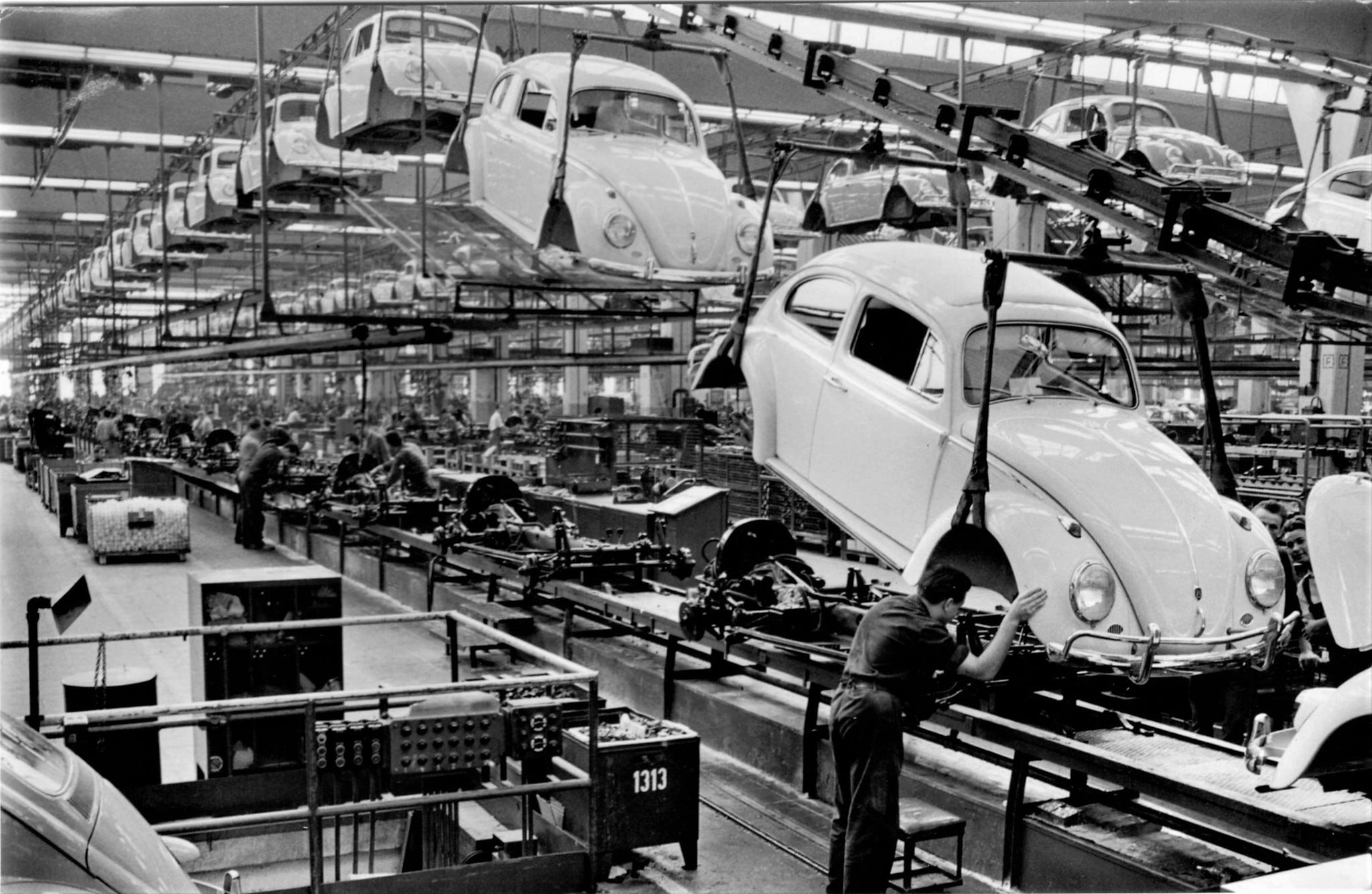
Manufacturing already had its Linux moment. It was the assembly line.
Here’s what keeps nagging us. If you’re thinking “wait — hasn’t manufacturing had its open, universal breakthrough before?” — you’re right. The assembly line.
Ford didn’t patent the moving assembly line. The principles were freely observable, and competitors adopted them within years. By the 1920s, every serious manufacturer in the world had reorganised around the same basic framework: standardised parts, sequential stations, specialised labour, continuous flow. It was open. It was universal. It transformed everything it touched. If that’s not a Linux moment, nothing is.
But here’s what the assembly line actually standardised: the process. The sequence of operations. The interchangeability of components. The division of labour. It worked brilliantly because it removed the need for intelligence at the point of execution. You didn’t need a skilled craftsman at every station — you needed someone who could repeat one task reliably. The intelligence was designed into the line itself by human engineers, and once designed, it was static.
Physical AI is trying to do the opposite. It’s trying to add intelligence back into the point of execution — a robot that adapts its grip to an irregular part, a cobot that learns a new task from demonstration, a quality system that catches defects no human programmed it to look for. And intelligence, unlike process, doesn’t standardise the same way. Every factory’s physics, equipment mix, product tolerances, and edge cases are different. You can’t observe a smart robot working in a Toyota plant and replicate its learned behaviour in your facility the way you could replicate an assembly line layout.
The assembly line’s genius was making things simpler and more predictable. Physical AI’s challenge is making things smarter and more adaptive. And that’s an order of magnitude harder to open-source.
So open source worked for software because software’s unit economics favour sharing. Copying code costs nothing. Testing it costs a cloud instance. Every contributor strengthens the whole, because every contribution benefits everyone equally.
Physical AI breaks that logic at every point. Testing a robot policy requires a robot. Validating it for production requires a certification process. A contribution that works on one hardware platform may be useless on another. The community splinters along hardware lines instead of accumulating around a shared platform.
ROS 2 succeeded precisely because it operates at the layer where physical AI is software — message passing, hardware abstraction, coordination. The further you move up the stack toward actual intelligence and real-world interaction, the harder it is to make the open model work.
That doesn’t mean open source is irrelevant to physical AI. It means the form it takes will be different. Not “download a robot brain from Hugging Face,” but more like: open simulation environments where anyone can generate training data (Cosmos, MuJoCo Playground). Open datasets collected from standardised hardware platforms (LeRobot). Open benchmarks that let researchers compare approaches without each owning the same robot. Open hardware designs that reduce the entry cost for experimentation.
The pieces are assembling. But they’re assembling at the pace of machine shops and safety certifications, not GitHub repos and Hugging Face uploads.
Where the energy actually is
If we’re mapping the open-source physical AI landscape in March 2026, the honest picture is: early, messy, but moving faster than a year ago.
Simulation is the beachhead. NVIDIA’s decision to open-weight Cosmos and expand Isaac Sim access is the single biggest unlock. If anyone can generate plausible physics-aware training data without owning the robot, you start to decouple the software iteration speed from the hardware constraint. Millions of Cosmos downloads suggest real adoption, not just curiosity.
Low-cost hardware is proliferating. The sub-$5,000 research robot was basically nonexistent two years ago. Now there are multiple credible options. None of them are production-grade — that’s the point. They’re experimentation platforms, the physical equivalent of Google Colab for language models. The more people who can afford to tinker, the faster the ecosystem learns.
Foundation models are arriving. NVIDIA’s GR00T N1.6, Google DeepMind’s vision-language-action models, and a handful of academic projects are trying to build general-purpose robot intelligence that transfers across tasks and platforms. We’re at the GPT-2 stage — impressive demos, limited real-world reliability. But the trajectory is clear.
The industrial incumbents are hedging. Siemens, ABB, Fanuc, KUKA, and several other Robotics and Industrial Automation players are all watching the open-source robotics space carefully. None of them are open-sourcing their core IP. But several are building compatibility with open tools — ABB’s integration with Omniverse, Siemens’ Industrial Copilot ecosystem, Fanuc’s expanding API access. The industrial world’s relationship with open source looks less like adoption and more like cautious co-existence.
So what does this mean for you?
If you’re in manufacturing and wondering whether open-source physical AI matters to your operation yet — it probably doesn’t. Today. But the trajectory matters a lot.
If you’re evaluating automation investments, understand that the technology landscape is shifting faster than the vendor sales cycle. A system you buy today from a traditional integrator will work fine. But in three to five years, the AI layer on top of that hardware will likely draw from open-source foundations — the same way enterprise software today runs on Linux without anyone thinking twice about it.
If you have any robotics or software capability in-house, start experimenting with the open tools. ROS 2, LeRobot, MuJoCo — none of these require a massive investment to explore. The learning compounds. The manufacturers who understand what’s possible with open physical AI will make better purchasing decisions when the technology matures.
If you’re a vendor or integrator, the message is blunter: open source is not your competitor today. It will be the substrate your products run on tomorrow. The integrators who figure out how to add proprietary value on top of open foundations — calibration, domain-specific tuning, safety certification, ongoing support — will thrive. The ones who rely on proprietary lock-in at every layer will face the same pressure that every closed-source software company faced once Linux matured.
The real question
Physical AI won’t have a single Linux moment — one definitive tipping point where an open platform becomes the universal standard. The hardware diversity, the safety requirements, and the capital costs prevent that kind of consolidation.
What it will have, we think, is a series of smaller moments. An open simulation platform that becomes the standard training environment. An open dataset standard that lets researchers share manipulation data across hardware platforms. An open safety framework that makes certification less opaque.
Each of those is worth watching. None of them is here yet. But if the past eighteen months in digital AI taught us anything, it’s that “not here yet” can become “everywhere” faster than anyone expects — once the structural conditions are right.
The manufacturers who are paying attention now won’t be the ones scrambling when it happens.
We’ll see you next week.
— The Industrial Brain team
If this was useful, subscribe. If you’re building or using open-source tools for physical AI and want to set us straight, we’re all ears. Reply to theindustrialbrain@gmail.com
Further reading
If you want to go deeper on any thread from this article, these are worth your time:
Stanford 2025 AI Index Report — The definitive annual survey of where AI stands. The source for the 1.7 percentage point gap and 280-fold cost collapse cited above. Essential context for understanding how fast the open-source digital AI ecosystem moved.
The state of open source AI models in 2025 (Red Hat Developer, January 2026) — Detailed breakdown of how open-source models closed the performance gap to near-parity with proprietary systems, and what enterprise adoption actually looks like.
AI goes physical: Navigating the convergence of AI and robotics (Deloitte, 2026) — Industry-focused analysis of where physical AI is headed commercially. Good for understanding the investment landscape and market trajectory.
Berkeley Humanoid Lite: An Open-source, Accessible, and Customizable 3D-printed Humanoid Robot (UC Berkeley, April 2025) — The technical paper behind the sub-$5,000 open-source humanoid. If you want to see what democratised physical AI hardware actually looks like today, start here.
ROS 2 Overview and Key Features (Robotics Tomorrow, May 2025) — Useful primer on the open-source middleware layer that runs the vast majority of new robotic platforms. Covers adoption growth and the gap between infrastructure and intelligence.
NVIDIA Opens Portals to World of Robotics With New Omniverse Libraries, Cosmos Physical AI Models and AI Computing Infrastructure (NVIDIA, 2025) — The announcement that opened Cosmos and expanded Isaac Sim access. Worth reading to understand what NVIDIA is betting will become the simulation substrate for physical AI.
Updated ISO 10218: Major Advancements in Industrial Robot Safety Standards (Association for Advancing Automation, 2025) — The first major revision of industrial robot safety standards since 2011. Now addresses AI-assisted systems and cybersecurity — directly relevant to the liability gap discussed above.